Forceps-Manipulation-Challenge
IROS 2026 Forceps-Based Fine Manipulation (FFM) Challenge
IROS 2026 Competition
The Forceps-Based Fine Manipulation (FFM) Challenge aims to advance robotic manipulation of very small objects, a capability that remains challenging for robotic systems while being essential in applications such as precision manufacturing, scientific experimentation, electronics assembly, and surgical robotics.
Inspired by surgical robotic manipulation, the competition promotes the use of accessible forceps-based robotic systems, such as EndoWrist instruments integrated with robotic arms, while extending the scope beyond medical applications. These approaches can help reduce barriers to entry compared to established platforms such as the da Vinci Research Kit (dVRK), enabling broader participation and encouraging innovation across the robotics community.
The competition focuses on three key research areas:
- Hardware Development
- Teleoperation
- Autonomous Control
Registration
Team Registration
Teams provide and operate their own robotic systems. 👉 Register as a Team https://forms.cloud.microsoft/Pages/ResponsePage.aspx?id=JsKqeAMvTUuQN7RtVsVSEAr_4z6hFmdLmqnnKCyMP9pUQk9ORjJTMVZSNExPU0tBRzhPN1FNNVU1Mi4u
Individual Registration
Individual participants evaluate and compare participating robot systems through teleoperation. 👉 Register as an Individual Participant https://forms.cloud.microsoft/Pages/ResponsePage.aspx?id=JsKqeAMvTUuQN7RtVsVSEAr_4z6hFmdLmqnnKCyMP9pUMjIxT0UxNzdQME4zNkhRTFNVTDZZMVIzQS4u
Participation Capacity
- Maximum 12 robot teams
- Maximum 60 individual participants Participation is accepted on a first-come, first-served basis.
Prizes
Prizes will be awarded to recognize outstanding performance in both the team and individual competitions.
Team Awards
🥇 1st Place Team Certificate, $100 Amazon Gift Card
Special Awards
🏆 Best Autonomous System Award Certificate
🏆 People’s Choice Best Design Award Certificate, $200 Amazon Gift Card
Individual Awards
🥇 Top Individual Participant Certificate, $200 Amazon Gift Card
🥈 Runner-Up Individual Participant Certificate, $100 Amazon Gift Card
Competition Tasks
Task 1: Needle Threading
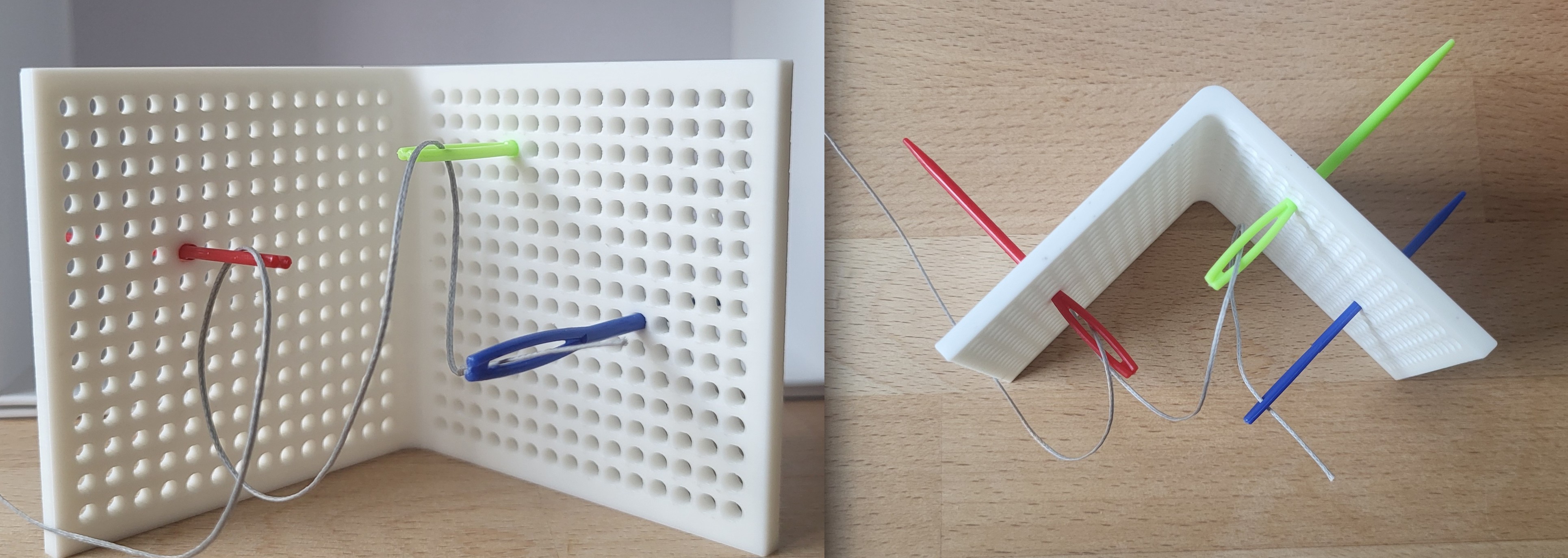
Three differently colored plastic sewing needles are inserted into randomly selected locations within an L-bracket needle holder. The orientations of the needle eyes differ by 90° in a randomized arrangement. The order of needle threading and the insertion directions are randomly selected before each trial.
Objective
Guide a thread through all three needle eyes according to:
- The specified order
- The specified insertion directions
Participants may request a new randomized arrangement before starting a trial.
Task 2: Screw Pick-and-Place
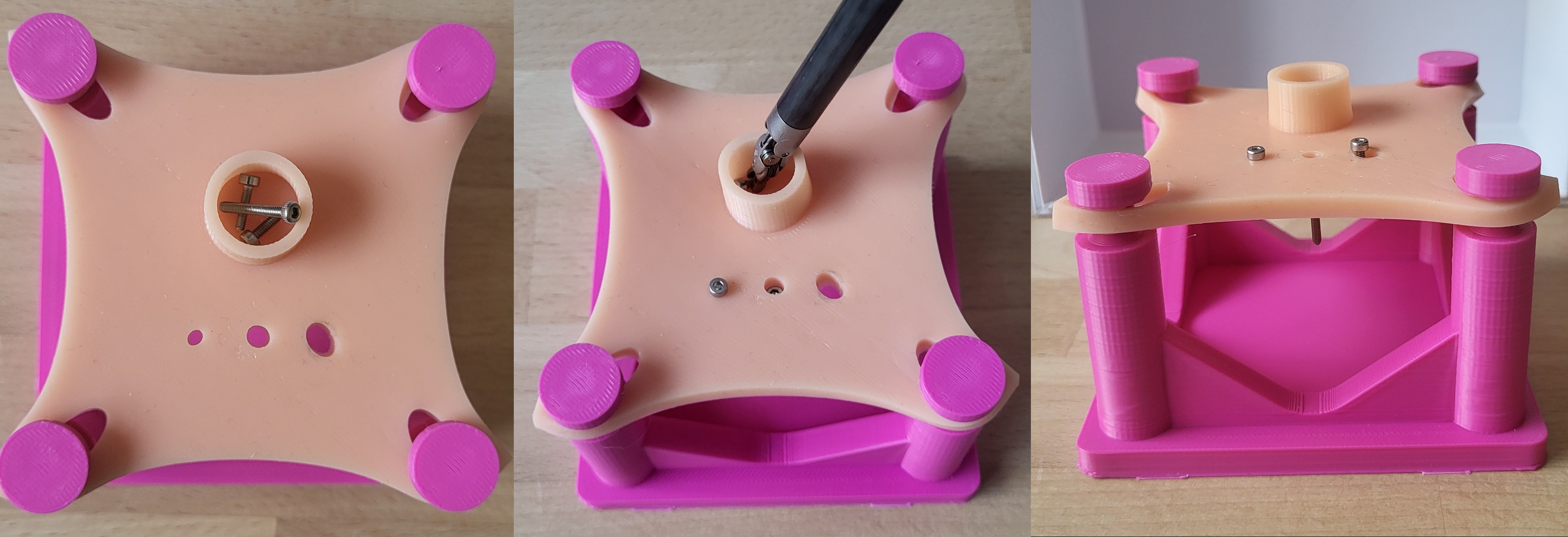
Three M2 screws are placed inside a silicone dish integrated into a silicone pad fixture. The silicone pad contains three insertion holes designed for one screw placement each.
Objective
Pick up each screw individually and insert it thread-first into one of the holes. A screw is considered successfully inserted when:
- the screw head rests on top of the silicone surface, or
- the screw passes completely through the hole.
Robot Platform Eligibility
The competition is intentionally platform-agnostic. Eligible systems include:
- Single-arm robots
- Dual-arm robots
- Multi-finger robotic hands
- Forceps-based robotic systems
- Surgical robotic research platforms
- Custom-built robotic manipulators
No remote center of motion (RCM) constraint is required.
Teams may place the competition scenarios anywhere within their robot workspace.
Competition Scenarios
The competition scenarios are based on the following components:
Commercial Components
- Fgruh 1260-piece M2 Hex Socket Head Screw Kit
- EcoFlex 00-20 FAST Silicone
- Silc Pig Silicone Pigments
- Lunarm Plastic Sewing Needles (70 mm)
- LEREATI 0.8 mm Waxed Thread
Custom Components
All custom components are manufactured using PLA on a Bambu Lab A1 Mini printer:
- Silicone Pad Mold
- Silicone Pad Mount
- Needle Holder L-Bracket
Teams are encouraged to obtain identical components for testing and system validation prior to the competition.
Download
👉 https://github.com/MEDCVR/Forceps-Manipulation-Challenge/raw/refs/heads/main/IROS_FFM_Setup.zip
Scoring
Task 1
- Each correctly threaded needle eye is worth: 1 point
- A fully successful trial therefore yields: 3 points
Task 2
- Each successfully inserted screw is worth: 1 point
- A fully successful trial therefore yields: 3 points
Team Competition
Teams accumulate points across three competition phases:
Day 1: Team Teleoperation
Robot systems are operated by members of the participating team.
Requirements
- Safe system demonstration
- Minimum 2 hours teleoperation operation
Scoring Objectives
- 10 successful Task 1 trials
- 10 successful Task 2 trials
Maximum Score: 60 points
Day 2: Independent Participant Evaluation
- Independent participants teleoperate competing robot systems (max. 6).
- Participants are assigned through a lottery process and will not operate systems from their own institutions.
Session Duration
20 minutes per robot
Trial Structure
- 6 Task 1 trials
- 6 Task 2 trials
- First trial serves as a warm-up and is not scored
Maximum Score
- 30 points per participant
- Best 3 robot systems counted
Maximum Day 2 Score: 90 points
Day 3: Autonomous Operation
- Teams may deploy autonomous control methods such as Imitation Learning.
- During official scoring, robot control computers may not access: Internet connections, local networks, external user inputs
Evaluation Window
- 1 hour
- Unlimited attempts are allowed.
- The 5 best successful trials for both tasks are counted.
Maximum Score: 30 points
Individual Competition
Participants accumulate points through:
Judging
Volunteer judges receive:
- 10 points per hour
- Maximum 30 points
Teleoperation Performance (Day 2)
Participants complete on max. 6 robot systems:
- Task 1 trials
- Task 2 trials
Only the three highest-scoring teleoperation sessions with different robot systems contribute to the final score (30 points each).
Maximum Individual Score: 120 points
Organizers
- Lueder A. Kahrs (University of Toronto)
- Peter Kazanzides (Johns Hopkins University)
- Loris Fichera (Worcester Polytechnic Institute)
- Adnan Munawar (Johns Hopkins University)
- Thomas Looi (The Hospital for Sick Children, Toronto)
- Tamás Haidegger (Óbuda University; Queen’s University)
- Christos Bergeles (King’s College London)
- Michael Yip (University of California San Diego)
- Nirmal Pol (University of Toronto)
- Aban Merali (King’s College London)
Questions
Questions can be submitted through the official competition form: https://forms.cloud.microsoft/Pages/ResponsePage.aspx?id=JsKqeAMvTUuQN7RtVsVSEAr_4z6hFmdLmqnnKCyMP9pUMUI0UzhRMlNKSTEyWEJYSDhWMkdBMFAyUC4u
Related Competitions
The FFM Challenge builds upon concepts explored in recent robotic manipulation and surgical robotics competitions:
- AI for Robotic Surgery, ICRA 2026
- International Challenge on Surgical Autonomy in Real-World Settings, Hamlyn Symposium 2026
- Dexterous Manipulation for Robotic Surgery, BioRob 2026
References
- K. L. Schwaner et al., MOPS: A Modular and Open Platform for Surgical Robotics Research, ISMR 2021.
- M. Habeeb et al., Development of an Open Platform Adaptor to Integrate Da Vinci Si Instruments with Collaborative Robotic Systems, HSMR 2025.
- C. D’Ettorre et al., Accelerating Surgical Robotics Research: A Review of 10 Years with the da Vinci Research Kit, IEEE Robotics and Automation Magazine, 2021.
Sponsors and Partners
Coming soon.
News
August 2026
Competition website updated with task descriptions, registration forms, and downloadable resources.